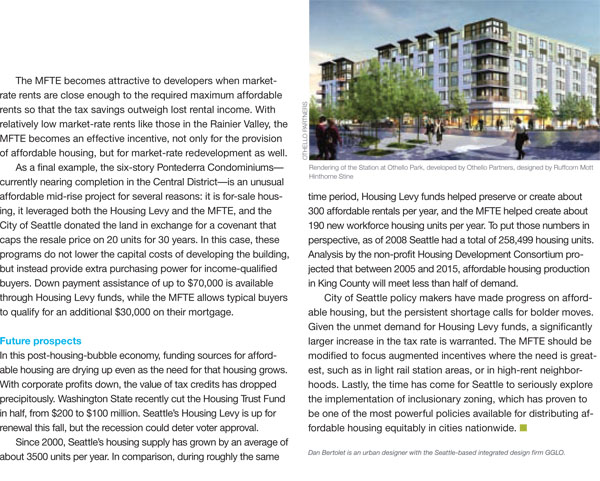
Prospects for Affordable Housing in Seattle

In the new issue of AIA Seattle Forum focussing on the ”Architecture of Inclusion.”  Read the whole thing here.

>>>
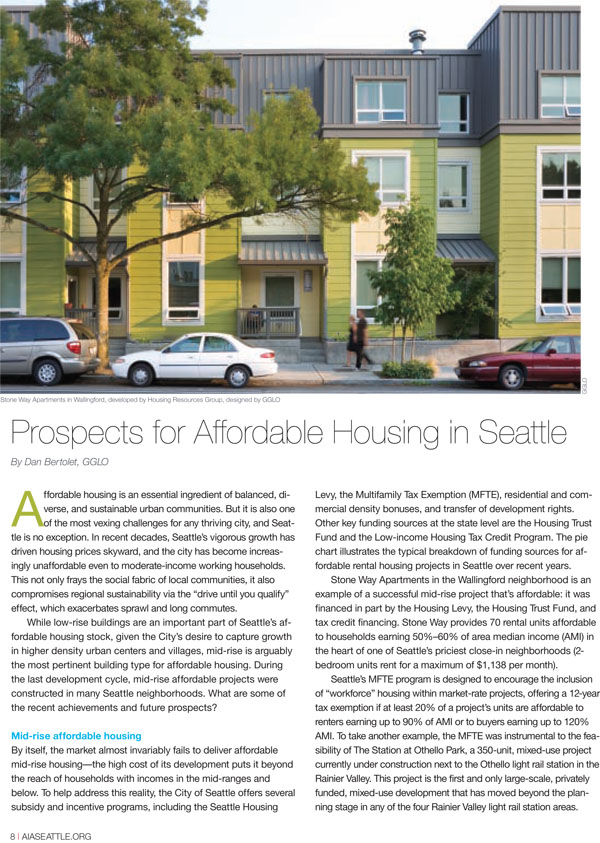
Forum p10

>>>

Layout 1

UPDATE: Here’s the pie chart that was mistakenly left out of the published article:

11 Responses to “Prospects for Affordable Housing in Seattle”

  1. John Jensen

    I think the pie chart is missing from the article.

  2. Harry

    Dan,

    Great article – of course since the article was submitted the voters of Seattle did pass that Housing Levy renewal – and with a 66% Yes vote!!

    Housing advocates are now turning to the upcoming State Legislative session to rebuild the State Housing Trust Fund by an infusion of $100 million. That’s a tall order in any year and especially when facing record budget deficits but in our favor is that the HTF is a public program that uniquely returns almost every dollar right back to the economy in jobs, materials purchase, construction spending, professional fees and taxes.

  3. mike

    at one point, i heard that lorig was talking about ‘workforce’ housing in rainier valley that was going to be $1200+ for a one bedroom.

    crappy slumlords building crappier buildings. hurrah.

  4. Chris

    With any discussion of “affordable housing” we need to define affordable. The post begins talking about “housing prices driven skyward,” becoming unaffordable to moderate income workers and then proceeds to talk about rental housing production programs targeted at<50% AMI workers, ie. people making less than half of the average income in the area, or people at the 25 percentile in income, which is not exactly moderate income, its low-income.

    The distinction is important, as the fluctuations in housing prices would do little to affect affordability for <50% AMI earners for whom publicly subsidized productions programs are targeted.

    With respect to the "workforce" housing (80%-100% AMI), the best thing we can hope for is government get out of the way and allow median prices to fall to levels that median income earners can afford. But instead the Feds are bound and determined to prop up housing prices by, among other programs:

    -first-time homebuyer tax credit
    -mortgage interest deduction
    -Fed purchase of MBS, driving rates lower
    -low-downpayments via FHA

    Low-income housing is another is, and relies much more on the production of rental units, most publicly subsidized, in a growing market like Seattle. For those units, your analysis is spot on in the last several paragraphs.

  5. Joshua Daniel Franklin

    @3, actually that sounds very reasonable for workforce housing. Check out Self-Sufficiency standard for King County, Washington. Annual wages of $67,171 means housing at $1,399 per month (rent plus utilities). Remember (as Chris just pointed out) workforce housing is not the same as low income housing. It’s housing for people with decent middle-income jobs who plainly cannot afford a $700k house on Queen Anne (or even a $400k townhouse in Pinehurst). Many who work downtown or near any light rail station would choose a decent TOD apartment.

  6. Anna M

    Thanks Dan. I hope someday, Inclusionary Housing will not be a dirty word in Seattle. It is as mundane a term as Tax Increment Financing in many other parts of the country including the majority of jurisdictions in California.

    Relying on voluntary programs will only get us so far. Inclusionary programs have always produced more affordable housing than voluntary programs.

  7. ktstine

    I second Anna M on inclusionary vs. incentive. It drives me nuts that we confuse the two here, and that both policy makers and advocates expect “incentive” zoning to be mandatory. It will never be mandatory until we have the guts to pass an ordinance and see if will hold up in court. Maybe McGinn is up for this challenge?

  8. Ross

    [Quote]Annual wages of $67,171 means housing at $1,399 per month (rent plus utilities). Remember (as Chris just pointed out) workforce housing is not the same as low income housing. It’s housing for people with decent middle-income jobs who plainly cannot afford a $700k house on Queen Anne (or even a $400k townhouse in Pinehurst).[/Quote]

    Your point may be valid, but the prices sound very high. I happen to live in Pinehurst, and would be very surprised if you couldn’t own a house for less than 1,399 a month. OK, that doesn’t include utilities, but still. A quick check of Zillow pretty much confirms my point (several houses for under $300K). I don’t live in the Rainier Valley, but a similar search yields similar results (obviously, it isn’t the bargain it was twenty years ago, but bargains are still to be had). Of course, I don’t know if any of those houses need major work.

  9. spencer

    Ross,
    The problem with the housing stock at the sub $300,000 in Seattle (if we are talking about the same homes in RV) is most of it needs updating and upgrading before it is really livable. Not all people at the income levels we are discussing here have the skills nor time to convert a run down house into something more livable.

    With increased difficulties we are now facing, would it be time to rethink the process at which we develop and construct our low income housing? If we can not rely on the previous models of financing and funding then we should be putting some effort into creating the new methods to developing low income housing?

    It is very unclear what Inclusionary Zoning means. Dan could you expound on what it is and what it does to the way we develop low income housing?

    I also wonder if Inclusionary Zoning is different from Inclusionary Housing that Anna M talks about. To me, Inclusionary Housing is about focusing on housing for a wider ranges of our population while Inclusionary Zoning would be about where we build more (dense?) housing types. Any help defining these would be helpful to the conversation. Anna? Dan?

  10. Ross

    OK, that makes sense. Like I said, I don’t know much about Rainier Valley anymore (my brother used to own a house there, but that was twenty years ago). I do feel confident, though, that you could get a decent house in Pinehurst for $300,000.

  11. spencer

    Dan?????? Help???? You out there?

Leave a Reply