Seattle’s Greenhouse Gas Inventory: Buildings
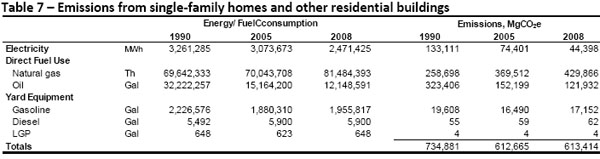
As noted in a previous post, the most striking success revealed in Seattle’s latest greenhouse gas (GHG) inventory is in the residential building sector: between 1990 and 2008, per capita GHG emissions dropped by 28 percent. To make sense of that, it helps to take a look at the residential energy data provided in the City’s full report, plotted below (taken from Table 7 at the bottom of the post):
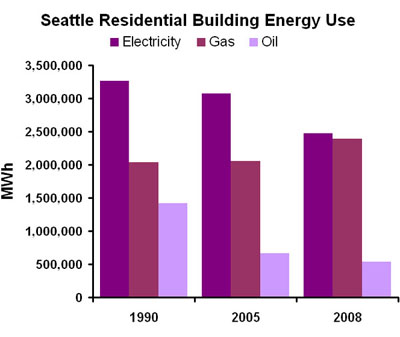
In Seattle’s residential building sector, between 1990 and 2008 total energy use fell by 20 percent, which, given the 16 percent growth in population during that time, is equivalent to a per capita reduction of 31 percent. That’s a lot. What happened?
The only reason the City’s report cites is conversion from oil to gas furnaces. One can speculate that tighter energy codes and efficiency upgrades (e.g. CFLs, insulation, etc.) also contributed. But here’s the thing: we seem to have made big improvements in our residential energy efficiency without really even trying that hard. It would be great to see some deeper analysis from the City on this, to help us better understand our progress.
The 20 percent drop in electricity use between 2005 and 2008 is curious—such a large decrease over a relatively short time period seems improbable. Either it’s bad data, or there’s something significant going on that we need to identify. The City report attributes the increase in gas use between 2005 and 2008 to an unusually cold winter—but many Seattle buildings are space heated with electricity, and thus one would also expect electrical demand to rise in cold weather.
So then, what could have had a big enough impact to cause that 20 percent net decrease in residential electricity use over three years? The recession? Lots and lots of CFLs? OSE or SCL, can you help us out here?
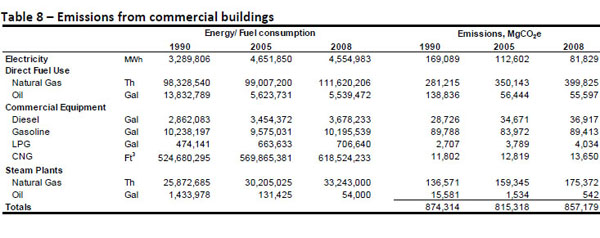
As is shown in Table 8 at the bottom of the post, unlike residential, commercial building energy use increased significantly between 1990 and 2008. Which raises an obvious question: why is residential doing so much better than commercial at improving efficiency? It matters, because the commercial sector consumes nearly twice the electricity that the residential sector does. Note also that there is a small drop in electricity use between 2005 and 2008, analogous to what was seen in residential. Related? The recession would seem to be a more plausible explanation in this case.
>>>
Now, to get a little deeper into the geeky weeds…
As can be seen in the bar chart, the dominant source of energy for residential buildings is electricity, but thanks to Seattle City Light and hydro dams, GHG emissions from electricity are relatively low compared to emissions from gas and oil (see GHG table here). If, however, Seattle’s electricity was like the average in the U.S, in 2008 the associated GHG emissions would be multiplied by about 38 times.
Again, since the electrical grid is regional, it seems it would be more realistic to apply a regional emissions factor to GHG inventory calcs. For the region encompassing WA, OR, and ID, the average emissions factor is about eight times larger than the emissions factor used in the 2008 Seattle inventory. And yes, that means the estimated GHG emissions from electricity would be eight times higher than the data points reported in the Seattle GHG inventory.
If the City of Seattle plans to develop policies based on GHG inventories, then care must be taken not to neglect the importance electricity simply because a localized interpretation says our particular electrons are carbon-free. And overall, since Seattle’s tentacles extend far beyond its borders, an honest accounting of GHG emissions must not be artificially bound by city lines.
UPDATE: See Sightline’s related post on GHGs and regional electricity.
>>>


Cool thing from previous thread:
Click here for a live feed to the public of the STEORN over-unity device demonstration – which started today and will run continually for six weeks.
http://www.livestream.com/steorn
Click here for their press release:
http://www.steorn.com/news/releases/?id=1161
and here for their website.
http://www.steorn.com/
…and here for the comic denouement:
I’m glad to see that you are at least in passing reminding people that we really shouldn’t get credit for the fact that we have access to hydro-power. I wish you would make this issue more prominent, however.
The issue is in fact worse than you think. You mention that the average on the regional grid is 8 times Seattle, but average is not what matters. All change is at the margin, so the key question is what is the marginal impact of Seattle’s electricity consumption?
The answer is that reducing our electric consumption by one kilowatt hour has exactly the same impact on greenhouse gases as if someone in new jersey does. Our hydropower is maxed out, and we will continue to max it out even if we reduce our electricity consumption. Marginal electricity is always coal. Thus dropping by one kWh means one less kWh produced by coal and all the GHG emissions associated with it. Our goal should be to get our electricity consumption down to the point in which the entire region is running on 100% hydropower.
If we use local average accounting rather than regional marginal accounting, we could become complacent about electricity and waste tremendous resources trying to tackle other more difficult sectors because we mistakenly thought electricity didn’t matter that much.
Electricity is the low-hanging fruit. It is the cheapest way, by far, to have the greatest impact.
I’m not sure I agree with Tony. My understanding is that our peak energy consumption just displaces what our region sells California. They have a much higher peak demand (thanks to air conditioning) and use our hydro. If there’s less hydro to sell them, they use natural gas peaking plants. So an argument can be made that we’re using natural gas with our peak Watt hours, which is certainly worse than hydro but much better than coal.
However, looking at Sightline’s raw data, Seattle proper uses over 1% coal, so perhaps Tony is right in some cases.
Does anyone know what the split is between condo/apartment-style homes and single family?
I imagine in a condo, the only real electric use today is heating and cooling, esp. the fridge.
In 2005, perhaps more people had energy-guzzling plasma TVs and tube TVs.
Today, super simple LCDs everywhere.
Also, a lot of people who are connected online watch media on their computers, instead of on TV – where they may have had a TV on for hours just a few years ago.
Just one small example of what has been a very quick change in the way people consume media.
Could a residential switch from electric to gas ranges (and perhaps dryers) have influenced that drop in electricity use?
For a while at least, in the opposite direction, there seemed to be a trend in older multifamily to stick renters with the heating bills more directly by converting from shared steam radiator heating systems (mostly gas) to individual electric ones.
How much electricity in out-of-town server farms do Seattle residents and businesses use? Would it make a significant difference if added to the local total?
Mr. Cortland — the fact that Steorn was not able to get the device working in 2007 does not detract from the present fact that the device is recharging itself and using less energy from the battery than it puts out. This effectively forms a revolution in physics as we know it and moreover and more importantly a radical harbinger of even greater things to come in the future of energy generation. Copenhagan is effectively mothballed with this and many other black shelved projects that will be coming out shortly, making “carbon emissions” a thing of the past. This is extremely fortuitous, given the eagerness of central bankers to begin a brand new global “derivatives” market from carbon taxation and generation.
Hang on, I think Seattle should get credit for its hydropwer.
I realize that plenty of smart folks disagree with me about this, but I think there’s a fascinating accounting question here. (To the extent that “fascinating accounting question” isn’t an oxymoron!) Tony’s point, and Dan’s too, is that as long as Seattle City Light is hooked into the Western grid, any hydro-generated kilowatt hour used in Seattle is, in some sense, denying a clean kilowatt hour to someone who will otherwise use a fossil-based kilowatt hour.
Now that analysis is obviously right from a macro perspective, but I’m not sure it’s a useful construct for a ghg inventory of a limited geographic area. In any case, this way of thinking about electricity emissions leads to some odd conclusions.
Imagine, for instance that the only transmission lines were from Seattle’s dams to the city. There’s no connection to the Western grid, just clean power running to consumers… in that case, Seattle’s power would be carbon neutral, right? (This would be just like me taking my house off the grid and living solely off rooftop solar panels.)
But as soon as SCL’s transmission lines connect to the Western grid, then according to this way of thinking, Seattle could no longer considered be carbon neutral — even if the generation and consumption are exactly the same! And we would not be carbon nuetral even if we supplied MORE hydropwer to the grid than we consume because we would still be consuming more than zero.
(This would be like my solar panels generating enough for me and my neighbor’s house too. I’m carbon nuetral when I’m off the grid, but if I connect to the grid to supply him with clean energy then I’m no longer carbon nuetral because I could be supplying ALL of my power to other users. Huh?)
In other words, because consumers in California will use coal power when they can’t access Seattle’s hydropower, Seattle is somehow to supposed to account for coal emissions from Cali. But in what world is Seattle responsible for what utilities and cities in California do?
What’s even weirder is that we don’t account for ghg emissions in this fashion for other sectors, such as transportation fuel where the dynamics are (roughly) similar. Consider that any gallon of gasoline I don’t use marginally lowers the global price of petroleum allowing someone else to burn an extra gallon. My conservation of oil will probably not affect global consumption a whit. But wouldn’t it seem peculiar to say that I am responsible for the gasoline emissions whether or not I burn it? So why are our ghg accounting assumptions different for electricity?
My point: local ghg inventories should tell us about what is emitted in our locality. They are an important accounting exercise that can give us policy guidance. But trying to embed local emissions in the tangled web of global energy flow and product demand sort of misses the point, in my view. Ultimately, we need national and international carbon policy — as Seattle’s inventory report clearly says — but that’s not really the purpose of a local inventory.
BTW, marginal power accounting is tricky for various reasons. But on the Western grid my understanding is that it’s probably natural gas. Coal power tends to be baseload.
Eric @8: You wanna take this outside? I guess I get stuck on the fairness aspect. Just because Seattle signed up for the hydro contract first, is it right that other cities in the region are then denied access to that zero-carbon energy? The dams are a regional asset, and their benefits should be distributed regionally. It’s not analogous to a rooftop PV because it isn’t on Seattle’s roof and Seattle didn’t pay for the rivers.
Agreed that it’s messy to try to include regional factors in a local inventory. But if you leave them out, then comparisons between Seattle and other cities lose much of their meaning, and you may also create a false sense of complacency.
“It’s not analogous to a rooftop PV because it isn’t on Seattle’s roof and Seattle didn’t pay for the rivers.”
Ah, but you didn’t pay for the sun in your rooftop PV either. I’d argue it’s like buying a PV panel on someone else’s roof. Or like someone else building a PV panel on their roof with a plan of selling the energy to you.
Seattle’s case is a little unusual because our electric utility is vertically integrated. SCL didn’t just sign a contract for the power. It actually built the dams and continues to own and operate them. So it seems to me that Seattle should be carbon neutral to the extent that, on net, we consume less power than we generate.
Anyway, even if we weren’t vertically integrated, I’d probably make the same argument. I don’t see how we can be held carbon-responsible for not preventing other people in other places from using carbon-based power. If PSE contracts with Colstrip or PGE contracts with Boardman, that’s their own business. I don’t think we’re “denying” anybody zero-carbon energy; they can go out and find their own.
But like I said: there are lots of smart folks who disagree with me about this. So you’ve got plenty of company, Dan!
[...] City and Multnomah County. The Plan includes a greenhouse gas (GHG)inventory, similar to the report recently published by the City of Seattle, but that’s where the similarity ends. Because apparently [...]
Nice post, this is exactly the information I was looking for. Are you going to be covering this topic in greater detail soon? Hope so! Thanks
In 1990, The very first of the new generation of high-rises (Columbia Tower, Seattle Municipal Tower, etc) were just coming on-line, and were fairly empty: Neither AT&T nor Key Bank were ever able to make a go of the SMT – that’s why the city took it off their hands (corporate welfare at its best)
So it stands to reason that the commercial usage has “increased significantly” – single family homes have a lot more flexibility in energy use, and people are usually motivated to keep costs down.
thank you for sharing your post.
Hey there!
My band just recorded our first proper song!!!
Please have a look, we’ve learnt a lot from your blog! :)
xxx
In looking for sites related to web hosting service and specifically comparison hosting linux plan web,your site came up.
Olá, primeiramente parabéns pelo blog. Achei o texto ótimo. Gostaria de saber se posso usar este texto no meu site – eu farei referência. Muito obrigado. Abs.
Hello buddie, was just into the internet seek some information and came across your blog. I am engraved by the posts that you own on this website. It reveals how good you conceive this issue. Bookmarked this website, will return for more. You, my friend, Cheers!!!
Everything About Fitness, Diet, and Health Related Issues.
enjoyed this post!
Merci, bravo et respect.
Thank you for give very nice knowledges. Your web is greatI am impressed by the information that you have on this blog. It shows how well you understand this subject. Bookmarked this page, will come back for more. You, my friend, ROCK! I found just the information I already searched everywhere and just couldn’t find. What a perfect site. Like this website your website is one of my new favs.I like this info shown and it has given me some sort of desire to succeed for some reason, so keep up the good work
Great information! I recently came across your blog and have been reading along. Its nice to know someone is still writing articles interesting to read. I don’t normally leave comments, but just thought I’d let you know I have enjoyed your writing and will keep visiting!
good article , hope to see more about this subject.
Hugeasscity…
[...] something about hugeasscity[...]…
This Blog is going places, the people, the layout, amazing to see such dedication and focus.
Spot on with this write-up, I actually assume this web site needs far more consideration. I’ll in all probability be again to read way more, thanks for that info.
The internet hides such awesome things! I can’t even remember how I got to this post, but I’m so glad I did. Your blog is chock full of interesting stuff, and I’ll definitely come back for more.
By simply expressing your knowledge you help other people via expressing your own personal observations. And I’ll let you know now your blogging served me personally. Cheers
greenhouse…
[...]Seattle’s Greenhouse Gas Inventory: Buildings | hugeasscity[...]…
Houston roofer,metal roofing contractor,roofing companies…
[...]Seattle’s Greenhouse Gas Inventory: Buildings | hugeasscity[...]…